
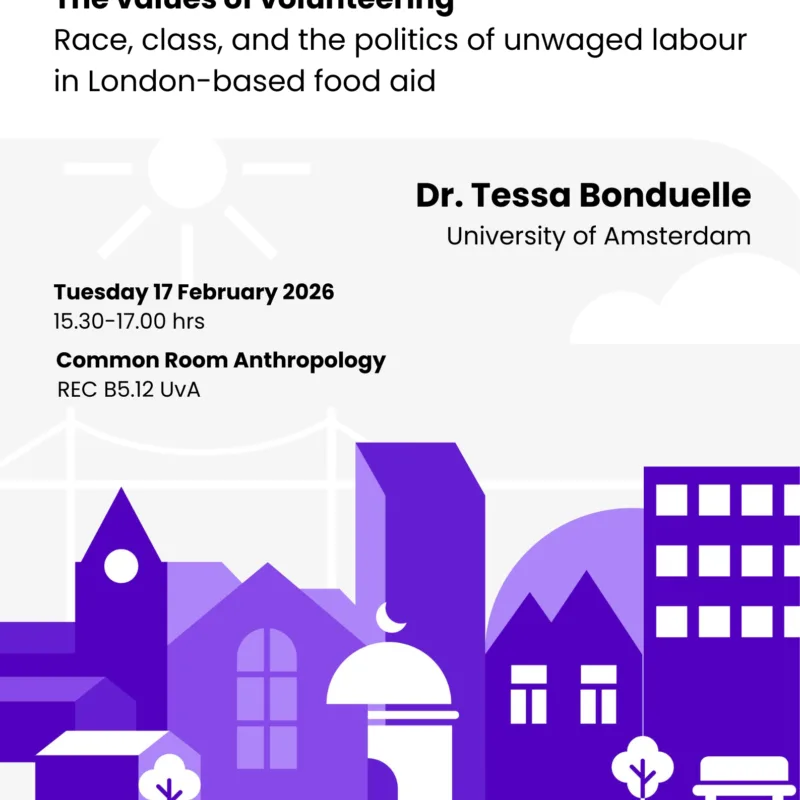
The values of volunteering: Race, class, and the politics of unwaged labour in London-based food aid by Tessa Bonduelle.
In the next Welfare Future Seminar, Tessa Bonduelle will talk about The values of volunteering: Race, class, and the politics of unwaged labour in London-based food aid. This seminar takes place on the 17th of February in Amsterdam.
This talk will explore the practices and politics of monetary and moral valuation in food aid volunteering. Focusing on a council-funded Food Hub in London, Dr. Bonduelle examines the intersection of (1) ascriptions of monetary worth to the goods circulated in food aid and to people’s labour with (2) the attribution of moral value. In an economy of surplus goods and labour, she asks how such monetary and moral values shape social relationships, and with what political consequences.
In bringing together a motley crew of retirees, homemakers, and irregularly employed individuals, the Food Hub coalesced as a space of surplus labour, circulating surplus food and hygiene products to those “in need.” Animated by notions of equality, inclusivity, justice, the Food Hub manager attempted to revalue volunteers and their labour.
On an individual level, the Food Hub manager sought to more justly compensate for volunteers’ unwaged labour, encouraging them to take from the available stock in boxes she estimated to be worth 70 GBP. In the context of material scarcity and deprivation, Food Hub volunteers took more than prescribed, took items proscribed, and told on each other, suggesting that their estimations of monetary and moral value did not align with those of the manager. Contestations over “just” redistribution and compensation played out in the open, in highly charged conflicts that drew upon racialized stereotypes of South Asians.
Beyond individual compensatory practices, the Food Hub manager endeavoured to revalue volunteers by organising group activities, including bike-riding workshops, wild camping, trips to the theatre, the opera, the cinema. These activities aimed to build community and collaboration, and to provide diverse opportunities for recreation. They also, however, bore the moral force of bourgeois productivity and carried classed understandings regarding the value of the outdoors, of learning new skills, and of doing something “educational.”
Dr. Bonduelle shows that attempts to monetarily and morally revalue surplus labour reinscribed sociopolitical differences of race and class within the Food Hub.
Practical information
What
Tessa Bonduelle, “The values of volunteering: Race, class, and the politics of unwaged labour in London-based food aid.”
When
17 February, 15.30-17.00, followed by drinks at CREA Café.
Where
REC B5.12, Common Room Anthropology (Roeterseiland, B-building, 5th floor)
If you are not able to join in person, you can also follow the talk and discussion via the live stream.
Welfare Futures Seminar Upcoming Events
10 March 2026 – Dimitris Soudias
21 April 2026 – John Clarke
Welfare Futures seminar series
The Welfare Futures seminar series is hosted by the Prototyping Welfare and Crafting Resilience projects, embedded in the Anthropology department of the University of Amsterdam. With talks every 4 weeks, it seeks to create a lively space for debate and bring together an interdisciplinary ethnographic community engaged in thinking about transforming welfare landscapes in Europe and beyond.
Bio Tessa Bonduelle
Dr. Tessa Bonduelle is a postdoctoral researcher in the project Prototyping Welfare in Europe: Experiments in State and Society, led by Anouk de Koning at the University of Amsterdam. Trained as a sociocultural anthropologist, Tessa’s work focuses on social provisioning and state (trans)formation in France and the UK, with a special focus on how welfare interventions in imagine and shape collectivities. Dr. Bonduelle received her PhD from the University of Toronto, in a Joint Educational Placement with l'Université Paris 8, where she researched the model of state-outsourced social work in France's asylum system. As part of the Prototyping Welfare project, Tessa is exploring how local welfare solutions reshape sociopolitical relations in the UK.